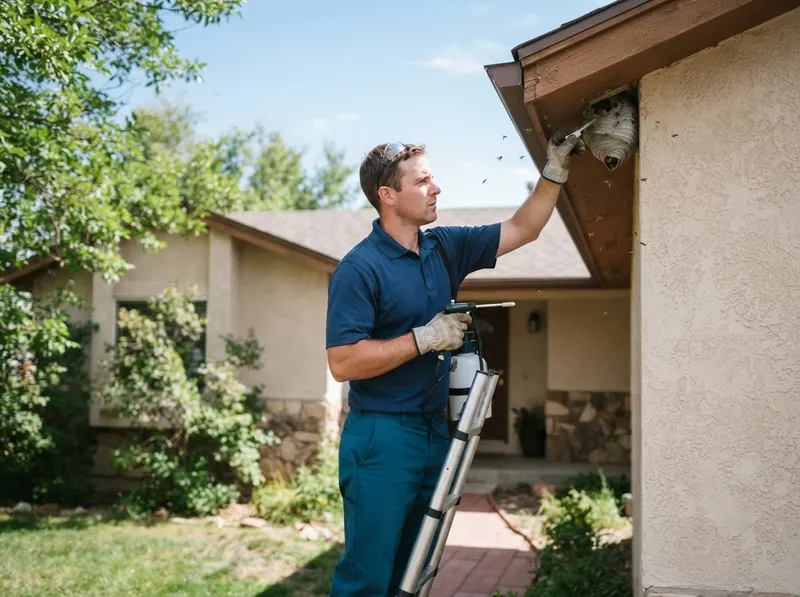
Stinging insect activity in the Grand Valley accelerates dramatically from late spring through early autumn, driven by semi-arid desert temperatures and irrigated landscape corridors. Paper wasps frequently suspend umbrella-shaped brood combs beneath sunny fascia boards in North Grand Junction and Appleton, while subterranean yellowjackets colonize abandoned rodent tunnels along irrigation ditches in Orchard Mesa and Pear Park. In elevated areas like the Redlands and the Ridges, canyon-facing roof soffits and stone retaining walls offer thermal shelter where colonies expand up to several thousand workers by August. Nests situated inside hollow structural walls or beneath composite deck framing require aerosol flushing agents paired with micro-encapsulated dust barriers, whereas exposed eave nests require contact knockdown agents applied through precision extension poles up to 24 feet.
Selecting professional stinging insect control balances colony location against structural intervention. An exposed paper wasp comb measuring four inches under a front porch overhang requires a single direct knockdown application and immediate scraping. Conversely, yellowjackets entering through weep holes or mortar seams near Downtown Grand Junction commercial storefronts require void-injection equipment to reach the hidden nesting core without forcing defensive hornets through interior drywall into occupied living spaces. Homeowners attempting retail spray-can suppression often trigger satellite dispersal, driving surviving foragers deeper into ceiling cavities or HVAC ducts.
Service protocols follow a four-step remediation standard. 1. Technicians identify flight trajectories and nest entrance points along exterior architecture, landscaping, or outbuildings. 2. Protective suits and high-volume delivery lances apply non-repellent or rapid-knockdown formulations directly into the primary comb structure. 3. Physical nest scrapers detach exterior satellite combs from soffits, decorative trim, and gutter troughs. 4. Residual dust applications inside perimeter voids and fascia corners suppress newly emerging pupae and returning foragers for up to 60 days. Operations are governed by a $200 minimum service charge, with exact pricing confirmed on-site prior to chemical application.