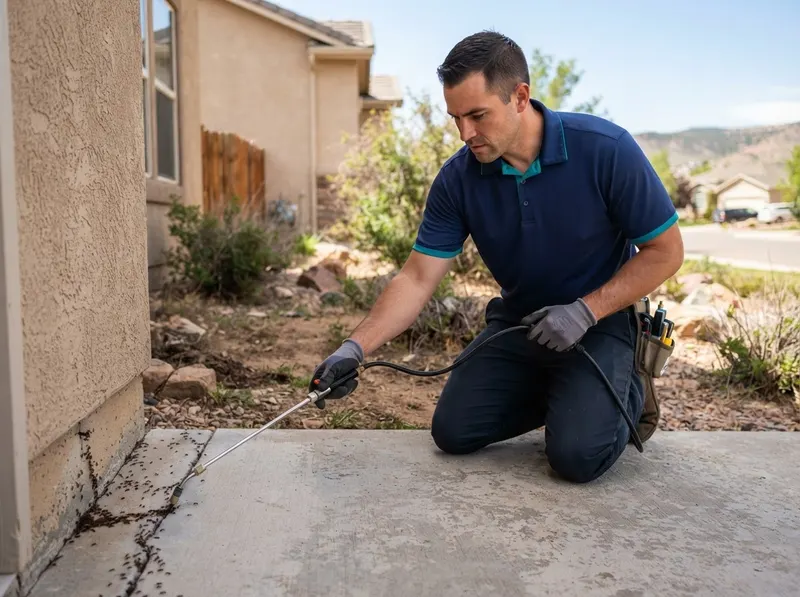
Nuisance ant infestations in Mesa County peak as regional soils warm and seasonal irrigation commences across the Grand Valley. Concrete flatwork common to Redlands and the Ridges creates warm nesting voids underneath driveways and foundation aprons, where pavement ants establish extensive colonies that push excavated dirt through expansion joints. Meanwhile, properties bordering agricultural ditch corridors in Appleton, Fruitvale, and Pear Park face foraging pressure from odorous house ants seeking indoor moisture sources near kitchens and utility penetrations. Structural treatments must distinguish between nuisance species and destructive wood-destroying organisms. Nuisance eradication targets structural food-foragers that do not consume timber, whereas carpenter ant protocols require specialized structural wall injection into damp wood members.
Effective eradication requires understanding the difference between store-bought repellent sprays and professional non-repellent transfer protocols. Over-the-counter synthetic pyrethroid sprays create a surface barrier that kills foraging worker ants on contact but causes odorous house ant colonies to undergo budding, where multiple queens scatter into separate wall cavities and multiply the nesting count. Professional service applications utilize slow-acting active ingredients such as fipronil or dinotefuran applied directly along foundation perimeters and trailing tracks. Worker ants cross these treated zones without detection, carrying the non-repellent micro-particles back into the subterranean gallery where social food sharing (trophallaxis) systematically eliminates the egg-laying queen within 7 to 14 days.
Regional factors directly dictate treatment longevity and application methods throughout the Grand Valley. Alkaline clay soils common near Orchard Mesa, Pomona Park, and North Grand Junction degrade conventional surface sprays faster than sandy loams, requiring targeted liquid band applications 3 feet up the exterior stem wall and 3 feet out onto adjacent soil. Xeriscaping, gravel mulch, and flagstone patios in properties near Colorado National Monument and Connected Lakes Section of James M. Robb - Colorado River State Park present deep void networks where surface mists fail to penetrate. In these environments, micro-granular formulations and specialized moisture-retaining gel baits inside tamper-resistant stations provide sustained active baiting beneath the surface line without washing away during landscape watering cycles.