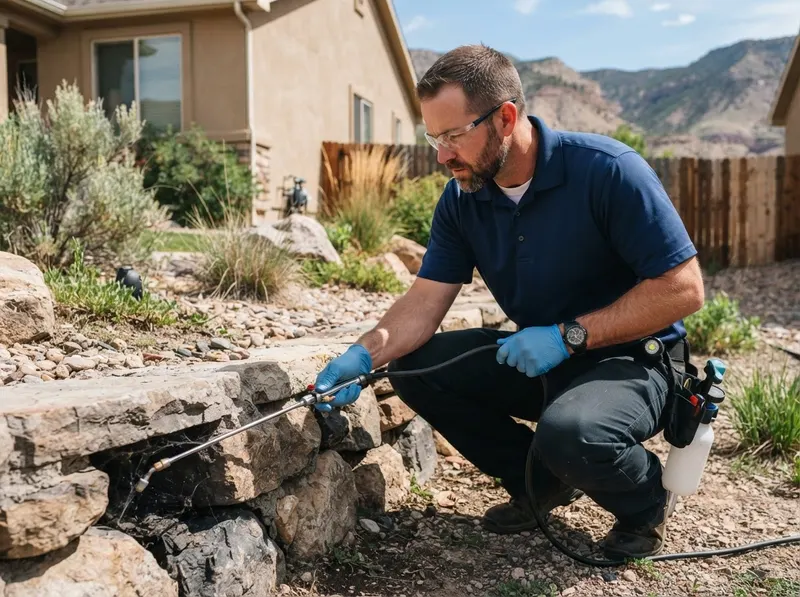
Western black widow spiders (Latrodectus hesperus) and arid desert species thrive in the semi-arid Grand Valley climate, where dry river rock landscaping, open brick weep screeds, and unconditioned outbuildings provide ideal harborage. In elevated, rocky terrain like the Redlands and the Ridges, spiders nest heavily within sandstone retaining walls, exterior crawl vents, and water meter boxes. Further east in Orchard Mesa, Pear Park, and Fruitvale, agricultural borders and irrigation pipe runs allow desert wolf spiders and funnel-web spiders to migrate directly toward foundation perimeters during late summer heat spikes. Virexa Insect Solutions structures treatments to address the microhabitats native to Mesa County properties, moving past temporary surface sprays to isolate entry points along slab edges, patio expansion joints, and shaded window wells.
Effective spider eradication requires separating true predatory control from standard broad-spectrum pest suppression. Because arachnids possess long legs that keep their bodies elevated above treated horizontal planes, standard residue walk-over provides minimal lethal uptake. Target management combines high-pressure microencapsulated barrier bands applied 3 feet up the exterior wall and 3 feet out onto the soil with focused pyrethroid dust injections inside structural voids. For older brick homes in Downtown Grand Junction and Pomona Park, tuckpointing cracks and utility penetrations receive fine void treatments to eliminate nesting female egg sacs. Technicians mechanically brush away existing cobwebs and egg silken casings using extending carbon-fiber poles, which disrupts territorial re-colonization and forces hidden spiders into contact with freshly placed residual barriers.
Property layout determines the operational trade-off between standalone exterior perimeter maintenance and comprehensive interior dusting. If spider activity remains isolated to exterior crawl space louvers, outbuildings, or detached garages typical of Appleton and North Grand Junction lots, an exterior-only barrier limits chemical exposure indoors while stopping perimeter ingress. Conversely, if egg sacs or mature females occupy interior baseboards, boiler closets, or unfinished basements, comprehensive indoor crack-and-crevice work is required. Interior remediation mandates clearing baseboard access and vacating treated rooms for 2 hours while aerosolized products dry. Every treatment protocol observes a strict $200 service minimum, covering foundational safety inspections, mechanical web disruption, and targeted residual barriers.